Alfprotocol – SIM racing has grown from a niche hobby to a mainstream gaming category, driven by the popularity of titles like iRacing, Assetto Corsa Competizione, and the F1 series. The hardware that supports SIM racing has evolved alongside the software. Fanatec’s Direct Drive 2 wheel base, launched in early 2026, represents the culmination of that evolution: a professional-grade SIM racing system that is accessible to consumers, delivering force feedback precision that was previously available only in commercial racing simulators.
The SIM Racing Revolution: How Fanatec’s Direct Drive 2 Is Bringing Pro-Level Gear to Consumers
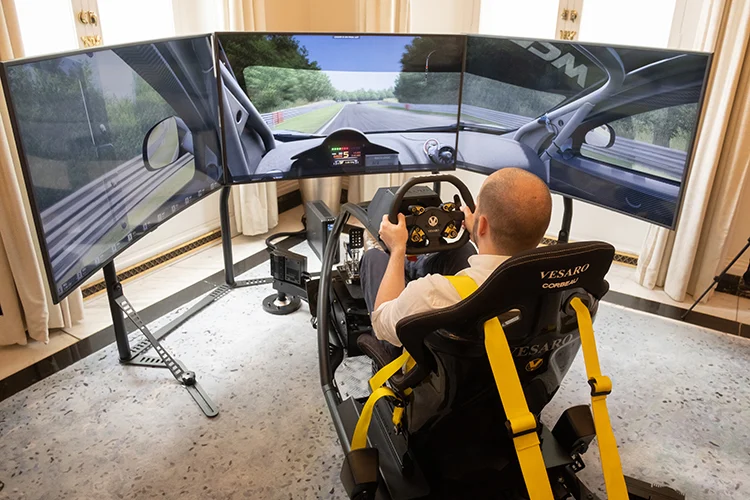
The Direct Drive 2 is the successor to Fanatec’s Direct Drive 1, which was already considered one of the best consumer wheel bases on the market. The new model increases torque output to 25 newton-meters, providing force feedback that can simulate the full range of forces experienced by a real race car driver. The torque is not about making the wheel harder to turn; it is about providing more dynamic range, allowing subtle forces to be felt alongside powerful ones. The result is a level of immersion that was previously impossible outside of professional training facilities.
The force feedback precision of the Direct Drive 2 is achieved through a new motor design and control algorithm. The motor uses a 32-bit processor that calculates force feedback at 1,000 times per second, providing updates that are effectively instantaneous. The algorithm simulates the physics of tire grip, suspension movement, and track surface with a level of detail that mimics real driving. The wheel can communicate the precise moment that tire grip is lost, the texture of the track surface, and the weight transfer under braking and acceleration.
The ecosystem of wheels and accessories for the Direct Drive 2 has expanded significantly. Fanatec now offers more than 20 wheel rims for the system, ranging from Formula-style wheels with extensive button arrays to classic round wheels for rally and drifting. The quick-release system has been redesigned to be even more rigid, eliminating the flex that could affect force feedback precision. The pedals have been updated with load-cell brake technology that measures pressure rather than position, providing braking feel that mirrors real racing.
The integration with SIM racing software has been improved through Fanatec’s partnership with the major developers. iRacing, Assetto Corsa Competizione, and the F1 series now include native support for the Direct Drive 2, with force feedback profiles tuned specifically for the hardware. The game can communicate more detailed force feedback information because the developers know the capabilities of the hardware. The integration reduces the setup complexity that was previously required to get the most out of direct drive systems.
The price of the Direct Drive 2 reflects its position as a premium product. The wheel base alone is $1,200, with wheel rims starting at $200 and pedals starting at $400. A complete setup can cost $2,000 or more, placing it out of reach for many SIM racing enthusiasts. Fanatec has addressed this with a lower-priced option, the CSL DD, which uses a similar motor design with reduced torque output at half the price. The company is also offering financing options that make the premium system more accessible.
The competition in the direct drive market has intensified. Logitech has entered the category with the G Pro Direct Drive, which offers 11 newton-meters of torque at a $1,000 price point. Thrustmaster has released the T-Direct, which targets the entry-level direct drive market at $600. The competition is driving prices down and features up, making direct drive technology accessible to a broader range of SIM racers. The category that was once limited to enthusiasts with substantial budgets is becoming mainstream.
The SIM racing revolution represented by the Direct Drive 2 is not just about hardware; it is about the convergence of gaming and training. Professional race car drivers use SIM racing systems to practice for real races, and the Direct Drive 2 provides feedback that is realistic enough to be useful for training. The line between gaming and professional training is blurring, and the hardware that supports SIM racing is evolving to meet the demands of both enthusiasts and professionals.